
A founder closes a seed round with a clean cap table. Eighteen months later the next round opens, and an early investor says, "We would like to use our pro-rata." It helps to know what that sentence means before the call, not during it.
What the right is
A pro-rata right lets an investor buy a share of a future round equal to their current ownership. The purpose is to hold the same percentage while new shares are issued. It is an option, not an obligation. In Vanneck deals, pro-rata rights are part of our standard terms.
A worked example
- A $500K check at a $10M post-money valuation is 5%.
- The company later raises $4M at a $20M post-money valuation. New investors receive 20% of the company ($4M divided by $20M).
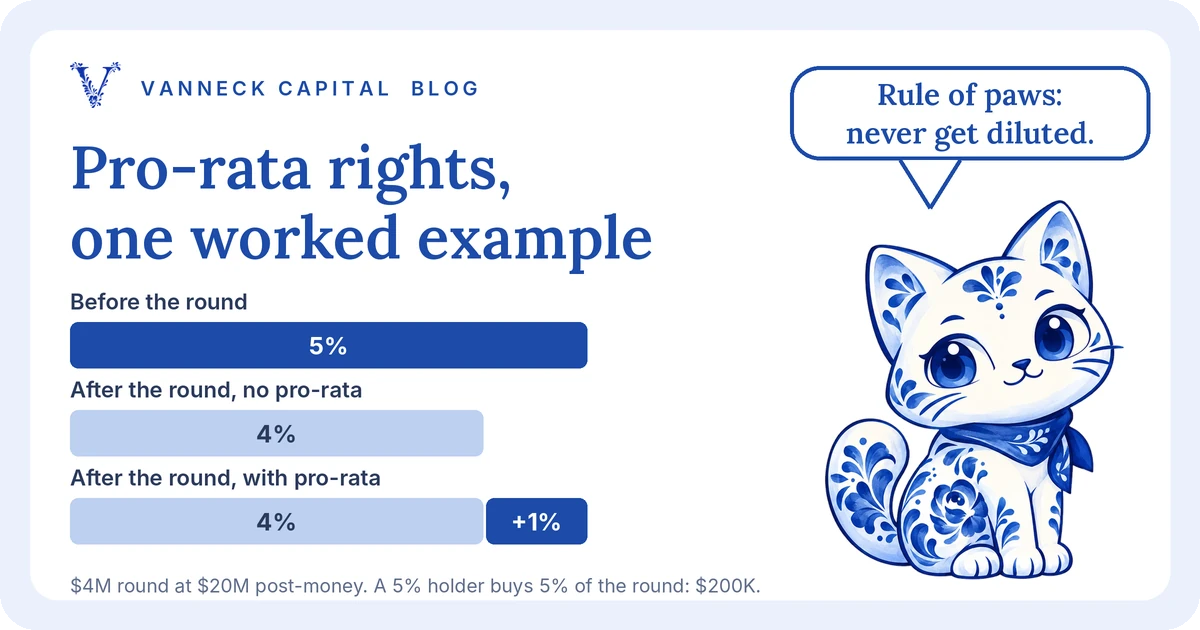
- An investor who does nothing is diluted from 5% to 4% (5% x (1 - 0.20)).
- With pro-rata, the investor buys 5% of the round, which is $200K (5% x $4M). That buys 1% of the company ($200K divided by $20M), and 4% plus 1% is 5% again.
The example is simplified. It ignores option pool changes and any other terms of the round.
What founders should plan for
- Reserve the allocation when you size the round. In the example, $200K of the $4M is spoken for before you call a single new investor. With several holders of pro-rata, the reserved share can be large.
- Ask each investor early whether they intend to use the right. A late answer can reshape the round.
- Pro-rata can be waived. A new lead sometimes asks existing investors to give up part of theirs. That is a negotiation, not a default.
What to check in a term sheet
- Who holds the right: all investors, or only those above a size threshold.
- What the percentage is measured on: fully diluted ownership or issued shares only.
- Whether the right covers every future round or only the next one, and when it expires.
- Whether it sits in the investment agreement or in a side letter.
Agree on these four points in the first term sheet. It is cheaper than agreeing on them in the middle of the next round.
This article is general information for founders and not legal or financial advice.